
Electronic Components Testing Lab
In today’s hyper-connected, technology-driven world, the performance and reliability of every smartphone, medical device, electric vehicle, and industrial control system hinge on the integrity of its smallest building blocks: electronic components. From resistors and capacitors to advanced microcontrollers and power modules, each part must function flawlessly under real-world conditions. This critical assurance is delivered by specialized **electronic components testing laboratories** highly controlled environments where engineering precision, standardized methodologies, and advanced instrumentation converge to validate component quality, detect defects, and certify compliance. More than just a quality checkpoint, a modern testing lab serves as a strategic partner in design validation, supply chain risk mitigation, and failure analysis. This article explores the core functions, equipment, standards, and value proposition of an electronic components testing lab, offering insight into how these facilities safeguard innovation across industries.
Core Functions of a Testing Lab
An electronic components testing lab performs three primary functions: incoming inspection, qualification testing, and failure analysis. Incoming inspection ensures that components received from suppliers especially from new or offshore vendors match datasheet specifications and are free from counterfeits, damage, or process deviations. Qualification testing goes further, subjecting components to environmental and electrical stresses (e.g., temperature cycling, humidity exposure, voltage margining) to verify long-term reliability before mass production. Failure analysis investigates field returns or production rejects to identify root causes such as material defects, design flaws, or assembly errors and prevent recurrence. Together, these functions create a closed-loop quality system that reduces risk, lowers warranty costs, and accelerates time-to-market.
Key Testing Capabilities and Equipment
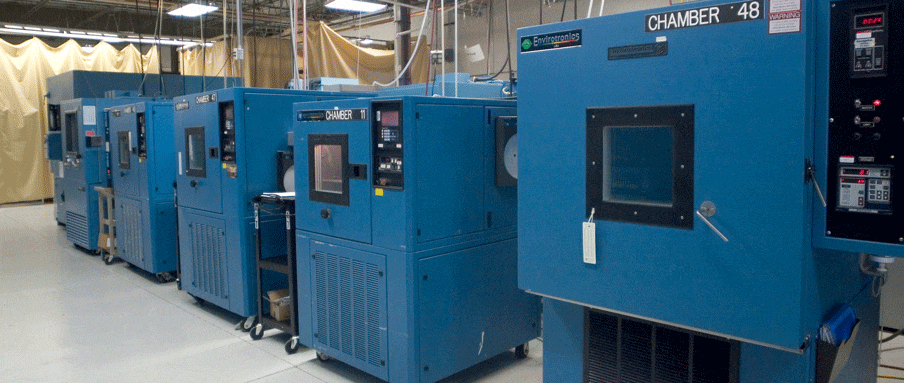
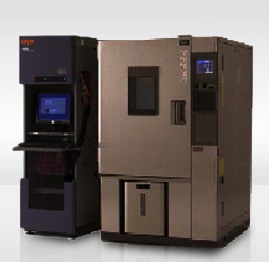
A well-equipped lab integrates a suite of advanced instruments tailored to component types and application requirements. Basic parametric testers (LCR meters, curve tracers) verify resistance, capacitance, inductance, and semiconductor characteristics. For dynamic validation, functional testers simulate real operating conditions—powering up ICs, loading firmware, and measuring responses under load. Environmental chambers replicate extreme temperatures (-65°C to +150°C), humidity (85% RH), and thermal shock to assess robustness per standards like AEC-Q100 (automotive) or MIL-STD-883 (military). X-ray inspection systems (2D and 3D AXI) non-destructively examine internal structures for voids, delamination, or bond wire defects. Scanning Acoustic Microscopy (SAM) detects hidden cracks or delamination in plastic packages. For counterfeit detection, labs combine decapsulation (chemical or mechanical removal of packaging) with die inspection, marking verification, and material analysis using techniques like Energy Dispersive X-ray Spectroscopy (EDS).
Industry Standards and Compliance
Testing labs operate under internationally recognized standards to ensure consistency and credibility. In automotive electronics, components must pass AEC-Q100 (ICs), AEC-Q200 (passives), and ISO 16750 (environmental loads). Aerospace and defense rely on MIL-STD-883 and ESA/SCC specifications. Medical devices follow IEC 60601-1 for electrical safety and biocompatibility. Consumer electronics often adhere to IPC standards (e.g., IPC-A-610 for acceptability, IPC-9252 for functional testing). Accredited labs (e.g., ISO/IEC 17025 certified) undergo rigorous audits to prove technical competence, measurement traceability, and documented procedures—making their reports admissible in regulatory submissions and legal disputes.
Why Companies Partner With Our Testing Lab
While large OEMs may maintain in-house labs, most design firms, startups, and contract manufacturers outsource testing to specialized third-party laboratories. Reasons include access to expensive equipment (e.g., thermal shock chambers, SAM), expert interpretation of complex failures, and regulatory credibility. A testing lab provides objective validation that components meet not just nominal specs, but worst-case operational demands. In an era of globalized supply chains and rising counterfeit risks—estimated to cost the electronics industry over $75 billion annually—third-party testing is a vital safeguard against substandard or fraudulent parts. Moreover, labs offer scalability: from single-component verification to high-volume batch screening, supporting everything from prototype validation to post-failure forensic investigation.
Why Choosing Us The Right Testing Lab
When selecting a lab, consider: accreditation (ISO/IEC 17025 is essential for legal defensibility), technical scope (do they test your specific component types and standards?), turnaround time, and report quality. A strong lab provides not just pass/fail results, but detailed data, failure imagery, and engineering insights. For high-reliability sectors, ensure the lab has experience with your industry’s specific protocols (e.g., automotive PPAP, aerospace DPA). Transparency, chain-of-custody documentation, and confidentiality agreements are also critical for protecting intellectual property.
Ultimately, an electronic components testing lab is more than a service provider—it is a guardian of trust in the electronics ecosystem. By rigorously validating every component before it powers a life-saving device or controls a self-driving car, these labs ensure that innovation is not compromised by hidden defects. As electronics grow more complex and embedded in critical infrastructure, the role of the testing lab will only become more indispensable.
A wide range of gadgets have various capacities, so they should be tried in an unexpected way. Also, there are various degrees of testing. To intensify the disarray, various organizations utilize distinctive wording and here and there, lamentably, with the goal to astound would-be purchasers into straightforward testing with great sounding names and abbreviations just to discover past the point of no return that implied two pins being tried with an uncalibrated handheld side interest multimeter. Foxconn Lab is totally straightforward from the underlying meeting and citation about precisely what the test technique and plan ought to be. The key is to be exact in correspondence just as in the test and detailing. It takes a completely prepared lab to have the option to test for parametric execution, usefulness, and as far as possible up to temperature reach and exchanging attributes (speed). Also, that is the way you truly recognize quality issues. Fundamental testing is periodically excessively essential.
We perform comprehensive electrical validation of transistors, diodes, microelectronics, and integrated circuits using official U.S. military standards—MIL-STD-202 for passive components and MIL-STD-750 for semiconductors. Unlike superficial checks, our tests evaluate full parametric curves, timing behavior, leakage currents, gain, capacitance, and thermal performance across specified operating ranges. Whether you’re qualifying a new supplier or validating obsolete inventory, our lab delivers data you can trust.
We are the Chip Police—and we’ve been fighting counterfeit electronics since 1996, long before industry standards existed. As the first counterfeit detection lab in China, we helped shape best practices now used globally. Our approach goes far beyond visual inspection: we combine electrical testing, X-ray analysis, decapsulation, material spectroscopy, and date code verification to expose remarking, recycling, out-of-spec dies, and outright fakes. For components like MLCCs or active discretes, we’ve developed proprietary test profiles that reveal what others miss.
Electronic components may function perfectly in a lab but real-world environments are far less forgiving. Temperature extremes, humidity, thermal cycling, and mechanical stress can expose hidden flaws that basic electrical testing misses. At FoxconnLab, Environmental Testing is a critical layer of validation that ensures components won’t just work today, but will keep working under the conditions your product actually faces.
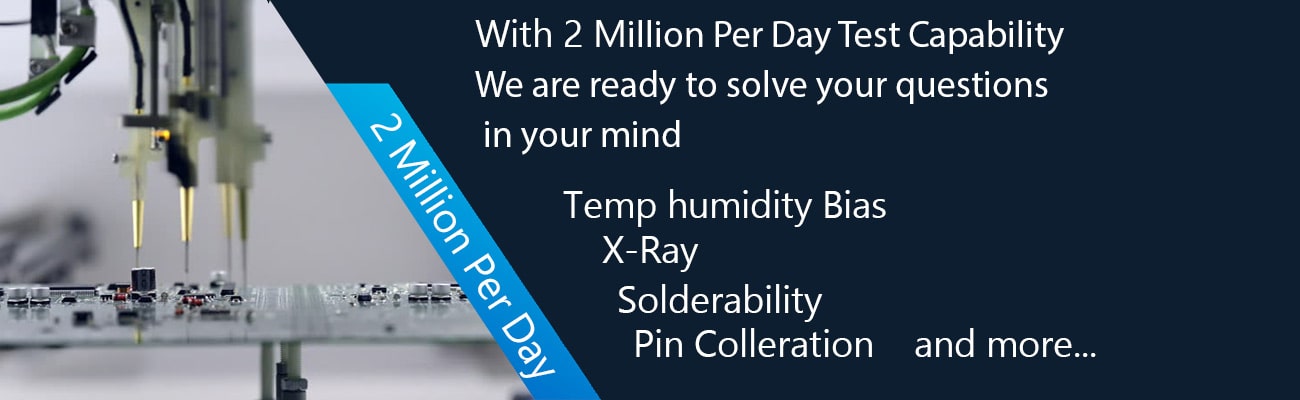
Many suppliers claim “testing,” but stop at room-temperature checks with uncalibrated tools often just two pins on a handheld multimeter. True reliability requires going further. FoxconnLab subjects components to controlled environmental stresses per industry standards like MIL-STD-202 and MIL-STD-883, including thermal shock (rapid temperature transitions), temperature-humidity bias (THB), high-temperature operating life (HTOL), and more. These tests reveal latent defects: solder fatigue, delamination, moisture-induced corrosion, or parametric drift that only appears under stress.
This is especially vital for counterfeit screening and lifecycle management. A recycled or remarked IC might pass a basic test but fail instantly at 85°C. Similarly, obsolete or refurbished parts must prove long-term stability before being used in medical, automotive, or industrial systems. Environmental testing answers the real question: “Will it survive where it’s deployed?”
FoxconnLab integrates environmental stress testing into a complete assurance workflow combining electrical validation, counterfeit detection, and lifecycle analysis. We’re transparent about test methods, profiles, and pass/fail criteria from quote to report. No jargon. No shortcuts.
Since 1996, we’ve treated every component as mission-critical because for your customer, it is.

Most
Sophisticated
Instruments
Family