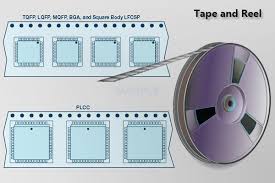
What Is Tape and Reeling?
Tape and reeling is the automated process of transferring electronic components from tubes, trays, bulk packs, or even loose lots into standardized embossed carrier tape, which is then wound onto a reel compatible with pick-and-place machines. The carrier tape consists of a base layer (typically polycarbonate or polyester) with precision-formed pockets that securely hold each component, covered by a transparent top tape (usually polyester film with heat-activated adhesive). Once sealed, the reel is labeled with part number, quantity, orientation, and lot data, ready for seamless integration into SMT production. While seemingly straightforward, the process demands micron-level alignment, static control, and handling discipline especially for miniature or moisture-sensitive devices (MSDs) to prevent damage, misorientation, or contamination.
Why Tape and Reeling Matters Beyond Automation
While the primary driver is SMT compatibility, tape and reeling delivers broader strategic benefits:
- Enables use of obsolete or excess inventory: Convert trayed legacy parts into reel format for new production runs.
- Supports low-volume/high-mix production: Reel small quantities without minimum order penalties from suppliers.
- Reduces handling errors: Eliminates manual kitting, minimizing ESD and mechanical damage risk.
- Improves traceability: Each reel can be barcoded with unique lot and date codes for full supply chain visibility.
- Facilitates testing integration: Components can be electrically tested, X-ray inspected, or baked *before* reeling ensuring only qualified parts are loaded.
Without this service, manufacturers face costly redesigns, line stoppages, or forced use of unreliable gray-market sources.
Technical Challenges in High-Quality Tape and Reeling
Not all tape and reeling services are equal. Poor execution can introduce latent defects that compromise yield and field reliability. Key technical considerations include:
Component Orientation and Polarity
Passive components like capacitors or diodes, and active devices like ICs with markings, must be placed in the tape with consistent rotational alignment (e.g., 0°, 90°, 180°). Misoriented parts cause SMT errors or functional failures. High-end reeling systems use vision inspection to verify orientation before sealing.
Static and ESD Control
Many semiconductors are ESD-sensitive. Reeling must occur in EPA (ESD-Protected Areas) with grounded workstations, ionizers, and static-dissipative materials. FoxconnLab enforces ANSI/ESD S20.20 protocols throughout the process.
Moisture Sensitivity Management
Moisture-sensitive devices (MSDs) classified per IPC/JEDEC J-STD-020 require special handling. If components are exposed during reeling, their floor life clock starts ticking. Best practice: perform reeling in a low-humidity dry room (<10% RH) or integrate baking per J-STD-033 *before* taping. Post-reeling, MSDs must be sealed in moisture barrier bags (MBB) with desiccant and humidity indicator cards (HIC) not just standard reels.
Precision Pocket Fit and Retention
Carrier tape pockets must match component dimensions within tight tolerances. Too loose, and parts shift or fall out; too tight, and insertion causes cracking (especially for brittle ceramics like MLCCs). Reputable labs maintain libraries of pocket dies for common and custom packages.
FoxconnLab’s Integrated Approach: Test, Verify, Then Reel
Many tape-and-reel vendors offer only mechanical repackaging. At FoxconnLab, we treat reeling as the final step in a full component assurance workflow. Before a single part enters the reeling machine, we offer:
- Electrical Testing per MIL-STD-202/750: Validate parametric performance, functionality, and switching characteristics not just “beep tests.”
- Counterfeit Detection: As the “Chip Police” since 1996, we screen for remarking, recycled dies, and out-of-spec materials using X-ray, decapsulation, and material analysis.
- Moisture Assessment & Baking: For MSDs, we verify exposure status and bake if needed before reeling.
- Visual & Dimensional Inspection: Confirm package integrity, lead coplanarity, and marking authenticity.
Only after passing these checks are components transferred to tape ensuring your SMT line receives not just *packaged* parts, but *trusted* parts.
Applications Across Critical Industries
Our tape-and-reel service supports clients in sectors where failure is not an option:
- Aerospace & Defense: Reeling MIL-spec discretes from tray to meet strict traceability and anti-counterfeit mandates.
- Automotive: Converting obsolete ECUs components into reel format for after-market or legacy vehicle production.
- Medical Devices: Ensuring ESD-safe, verified reeling of implantable-grade sensors and ICs.
- Industrial Automation: Supporting high-mix control board builds with small-quantity reeling of specialized optocouplers or power modules.
Quality Standards and Traceability
FoxconnLab’s tape-and-reel operations are backed by our ISO/IEC 17025 accreditation, ensuring technical competence and metrological traceability. Every reel includes:
– Unique batch ID and barcode
– Component orientation diagram
– Quantity verification (±0 tolerance)
– Lot/date code preservation
– Optional dry-pack sealing for MSDs
This level of documentation satisfies AS9100, IATF 16949, and FDA audit requirements.
When to Choose Professional Tape and Reeling
Consider FoxconnLab’s service if you:
– Have trayed or loose components you need to run on SMT lines
– Are managing obsolescence and need to repackage lifetime buys
– Source from brokers or excess channels and require pre-qualification
– Need small quantities without supplier MOQs
– Require full counterfeit screening + reeling in one workflow
More Than Repackaging It’s Risk Mitigation
Tape and reeling, when executed with discipline and integrated quality controls, transforms component logistics from a vulnerability into a strategic advantage. At FoxconnLab, we combine decades of frontline experience since 1996, before industry standards were formalized with MIL-STD testing rigor and counterfeit detection expertise to ensure that every reel we deliver isn’t just compatible with your machine, but worthy of your brand. In a supply chain rife with risk, trust isn’t assumed it’s engineered. And it starts with how your components are tested, verified, and packaged.
Frequently Asked Questions (FAQ)
What makes FoxconnLab’s component testing different from other labs?
Many labs offer “basic” testing that may only check two pins with an uncalibrated multimeter. FoxconnLab performs comprehensive, standards-based validation per MIL-STD-202 (for passives) and MIL-STD-750 (for semiconductors), measuring parametric performance, functionality, temperature response, and switching speed. We’re fully transparent—from quote to report—about test methods, equipment calibration, and pass/fail criteria. No misleading jargon, no hidden shortcuts.
Do you test small orders or single components?
Yes. FoxconnLab provides quick-turn, cost-effective testing for ALL order sizes—from a single IC to full production lots. We understand that counterfeit risk and obsolescence affect even the smallest projects, so we never impose minimum order quantities.
How do you detect counterfeit electronic components?
As the “Chip Police” since 1996—and the first counterfeit detection lab in China—we use a multi-layered approach: electrical testing, X-ray inspection, optical microscopy, decapsulation, material analysis, date code verification, and traceability audits. For example, our MLCC and Active Discrete test profiles go far beyond simple pass/fail checks to uncover remarking, recycled dies, or out-of-spec materials.
Are you accredited?
Yes. FoxconnLab is ISO/IEC 17025 accredited, ensuring our test methods, equipment calibration, and reporting meet international standards for technical competence and reliability.
What is Electronic Lifecycle Testing, and why do I need it?
Lifecycle testing validates whether obsolete, refurbished, or newly sourced components will perform reliably over your product’s intended lifetime. We assess parametric drift, thermal stress response, and functional margins to prevent surprises during production or in the field. This is critical when using lifetime buys, second-source parts, or next-gen replacements in legacy designs.
Can you help if my component is marked as “obsolete”?
Absolutely. We specialize in qualifying obsolete and excess inventory. Beyond testing, we support obsolescence mitigation strategies including lifetime purchase validation, cross-reference verification, and design-for-replacement guidance to maintain signal integrity and timing margins.
How quickly can I get results?
FoxconnLab is designed for quick-turn service. Standard electrical testing and counterfeit screening are typically completed within 1–3 business days. Expedited options are available for urgent programs.
Do you offer tape and reeling or dry pack services?
Yes. We provide integrated value-added services including tape and reeling (with orientation verification), dry pack sealing per J-STD-033, and moisture-sensitive device (MSD) baking—often combined with pre-reeling electrical validation to ensure only qualified components are packaged.